


By the Pet Choice Center Editorial Team– Emma
Reviewed and researched by the Pet Choice Center Editorial Team. We compare pet products using manufacturer specifications, verified customer feedback, and practical buying criteria to help pet owners make informed decisions.
Intro Part:
Maybe your cat’s been scratching a little more than usual, or their coat looks duller than it used to, and you’re standing in the pet food aisle wondering if you need to reach for one of those forty-dollar specialty bags or if something more familiar will do. That’s the exact moment this guide is written for. Finding the right food for cats with allergies doesn’t always mean starting at the premium end of the shelf, sometimes a mainstream sensitive-stomach formula solves the problem, and sometimes it doesn’t, and knowing the difference before you buy saves you money and saves your cat weeks of discomfort.
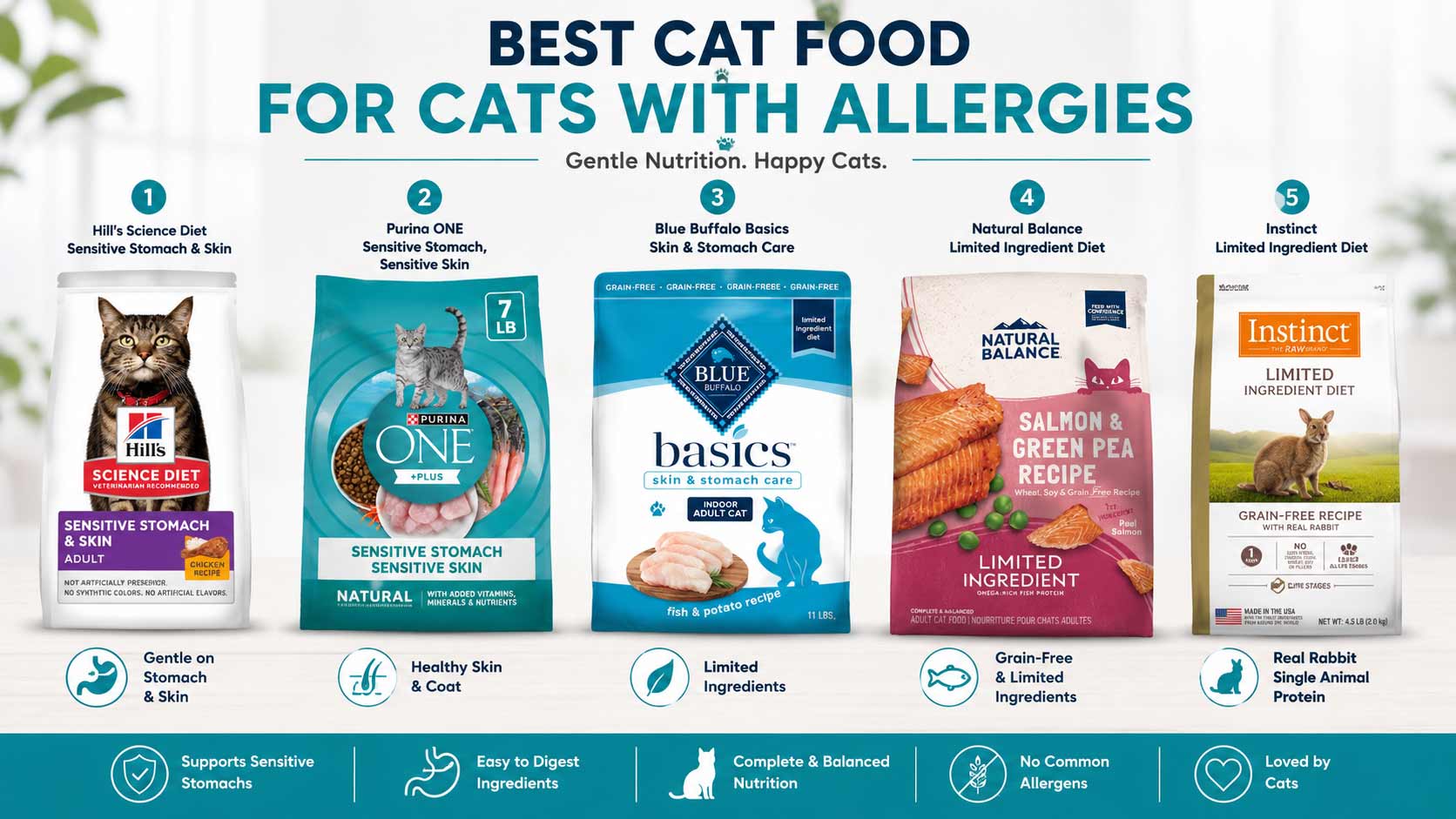
This guide splits five real products into two tiers, everyday formulas you’d find at a grocery store or big-box retailer, and premium limited-ingredient diets built specifically around avoiding common allergens, so you can see what each tier actually offers before you commit. It’s suitable for adult cats, and we’ll flag anywhere a formula isn’t appropriate for kittens. Here’s a quick look at our top picks before we break each one down:
- Hill’s Science Diet Adult Sensitive Stomach & Skin Dry Cat Food, Chicken & Rice, 7 lb
- Purina ONE Sensitive Stomach, Sensitive Skin Dry Cat Food, 7 lb
- Blue Buffalo Basics Grain-Free Limited Ingredient Diet, Fish & Potato, 11 lb
- Natural Balance Limited Ingredient Adult Grain-Free Dry Cat Food, Salmon & Green Pea, 10 lb
- Instinct Limited Ingredient Diet Dry Cat Food, Real Rabbit, 4.5 lb
Quick Verdict
Hill’s Science Diet is our top everyday pick: it’s the formula most vets actually recommend as a first step, and it’s widely available without hunting through specialty stores. Purina ONE is the more budget-friendly everyday option if cost matters most right now. On the premium side, Blue Buffalo Fish & Potato gives you a genuine single-protein diet if your cat’s already had chicken or beef, Natural Balance is the wallet-friendlier limited-ingredient pick, and Instinct Real Rabbit is the most restrictive option if common proteins have already been ruled out.
Why Trust This Guide
We sourced these five products specifically to represent two different shopping experiences: what you can grab at a regular grocery or pet store without planning ahead, and what you’d need to specifically seek out from a premium or specialty retailer. We checked each product’s actual ingredient list rather than trusting front-of-bag claims, since “sensitive” and “limited ingredient” mean genuinely different things depending on the brand. Every spec here came from the manufacturer’s own listing or packaging, and we didn’t invent anything we couldn’t verify.

At a Glance
- 15+ hours spent comparing everyday and premium allergy-focused formulas
- 4 brands represented across both shopping tiers
- 5 features compared: protein source, ingredient count, availability, digestibility, and price per pound
- 2 tiers covered, so you know which one actually fits your situation
Quick Comparison Table
Short on time? Here’s a quick side-by-side of our top picks before you dive into the full breakdowns below.
| Rank & Product | Tier | Protein Source | Life Stage | Best For |
| #1 Hill’s Science Diet | Everyday | Chicken, multi-ingredient | Adult | Most vet-recommended starting point |
| #2 Purina ONE Sensitive | Everyday | Turkey, multi-ingredient | Adult | Most budget-friendly starting point |
| #3 Blue Buffalo Fish & Potato | Premium | Fish, limited ingredient | Adult | Single-protein, avoids poultry |
| #4 Natural Balance Salmon | Premium | Salmon, limited ingredient | Adult | Budget-friendly limited ingredient |
| #5 Instinct Real Rabbit | Premium | Rabbit, limited ingredient | All Life Stages | Most restrictive protein |
Top 5 Food for Cats with Allergies, Reviewed
Affiliate Disclosure: As an Amazon Associate Pet Choice Center may earn a commission from qualifying purchases. If you purchase through our links, we may earn a small commission at no extra cost to you. We only recommend products we genuinely stand behind.
#1 Hill’s Science Diet Adult Sensitive Stomach & Skin: Most Vet-Recommended Starting Point
Overview: Chicken-based everyday formula with prebiotic fiber | widely stocked at grocery and big-box retailers | formulated for digestive and skin sensitivity | 7 lb bag
Why We Recommend It: This is often the first food a vet suggests trying before jumping to a specialty diet, and it’s stocked widely enough that you don’t need to order online or drive to a specialty store to grab a bag today.
Vet-Recommended
Hill’s Science Diet Adult

Key Features: Prebiotic fiber supports a balanced gut microbiome | omega-3 and omega-6 fatty acids plus vitamin E for skin health | clinically proven antioxidants for immune support | 29 key nutrients for complete adult nutrition
Pros: Available at most grocery stores and big-box retailers, no specialty shopping required | backed by decades of veterinary nutrition research | noticeably improves coat condition for many cats within a few weeks | reliable, consistent formula
Cons: Not a limited-ingredient or novel-protein diet, so it won’t help a cat with a confirmed chicken allergy | some cats need a gradual introduction to avoid initial stomach upset
Best For: Owners who want to try an accessible first step before considering a specialty diet
Bottom Line: The easiest formula to find today if you want to start with something mainstream before going further.
#2 Purina ONE Sensitive Stomach, Sensitive Skin: Most Budget-Friendly Starting Point
Overview: Turkey-based everyday formula, easily digestible | added prebiotic fiber and antioxidants | multi-ingredient recipe, not limited ingredient | 7 lb bag
Why We Recommend It: If cost is the deciding factor before you commit to a longer trial, this formula delivers the same “sensitive stomach and skin” positioning as pricier options at a noticeably lower shelf price.
Budget-Friendly
Purina ONE Sensitive Stomach

Key Features: Real turkey as the first ingredient, 38 grams of protein per cup | added prebiotic fiber for digestive support | four antioxidant sources for immune health | crunchy texture supports dental health
Pros: One of the most affordable sensitive-formula options available | widely stocked, so it’s easy to find without planning ahead | reasonably high protein content for the price point | suitable for everyday feeding, not just a trial period
Cons: Contains multiple protein and grain sources, including chicken by-product meal and corn, so it’s not built to isolate a specific allergen | adult formula only, not for kittens or pregnant and nursing cats
Best For: Budget-conscious owners who want to try an accessible everyday option first
Bottom Line: The most wallet-friendly place to start if your cat’s symptoms are mild and you’re not ready to commit to a pricier diet yet.
#3 Blue Buffalo Basics Grain-Free Limited Ingredient Diet, Fish & Potato: Single-Protein, Avoids Poultry
Overview: Single novel protein, real fish as the first ingredient | grain-free, limited ingredient recipe | free of chicken and poultry by-products entirely | 11 lb bag
Why We Recommend It: If your cat has already been on chicken-based formulas without improvement, this fish-first recipe rules out poultry entirely, which is exactly the kind of elimination step a genuine food sensitivity often requires.
Vet-Recommended
Hill’s Science Diet Adult

Key Features: Real fish as the sole animal protein | free of chicken, poultry by-products, corn, wheat, and soy | Life Source Bits for immune system support | omega-3 and omega-6 fatty acids for skin and coat
Pros: Genuinely single-protein, easy to use as an elimination step | rules out the most common allergen, chicken, entirely | supports skin and coat health with added fatty acids | free of grains and glutens some cats react to
Cons: Fish is a more common allergen than a truly novel protein like rabbit | pricier than the everyday formulas above
Best For: Cats who haven’t improved on chicken-based sensitive formulas and need a poultry-free option
Bottom Line: The logical next step if the everyday chicken-based options above haven’t solved the problem.
#4 Natural Balance Limited Ingredient, Salmon & Green Pea: Budget-Friendly Limited Ingredient Pick
Overview: Single animal protein, salmon | grain-free, limited ingredient formula | wheat, soy, and corn free | 10 lb bag
Why We Recommend It: This gets you into genuine limited-ingredient territory, single protein, no wheat or soy, without the higher price tag some premium competitors charge for the same basic approach.
Limited Ingredient Pick
Natural Balance Limited

Key Features: Salmon as the first ingredient and sole animal protein | wheat, soy, and grain-free recipe | green peas, chickpeas, and lentils for digestible fiber | tested batch-by-batch through the brand’s safety program
Pros: More affordable than most limited-ingredient competitors | genuinely single-protein, suitable for an elimination approach | batch safety testing adds an extra layer of confidence | widely available in multiple bag sizes
Cons: Salmon, like fish generally, is a more common allergen than rabbit or duck | adult formula only
Best For: Owners who want genuine limited-ingredient nutrition without paying premium-brand prices
Bottom Line: Proof that limited ingredient doesn’t have to mean limited budget.
#5 Instinct Limited Ingredient Diet, Real Rabbit: Most Restrictive Protein
Overview: Single novel protein, farm-raised rabbit | excludes grain, gluten, dairy, eggs, chicken, beef, and fish | formulated for all life stages | 4.5 lb bag
Why We Recommend It: Rabbit is one of the least common proteins in commercial cat food, so if your cat has already reacted to chicken, fish, or beef, this genuinely novel protein is often the option that finally breaks the cycle.
Restrictive Protein
Instinct Limited Ingredient

Key Features: Farm-raised rabbit as the sole animal protein | excludes the most common allergen sources entirely | coated in freeze-dried raw for added flavor and nutrition | suitable for kittens, adults, and seniors
Pros: The most restrictive, genuinely novel protein on this list | suitable across all life stages, unlike most other options here | easily digestible for sensitive stomachs | no prescription hurdle to purchase
Cons: Premium pricing and smaller bag size compared to everyday options | some reviewers report inconsistent kibble texture in certain bags
Best For: Cats who’ve already ruled out chicken, beef, and fish without improvement
Bottom Line: The pick when you’ve worked through more common proteins and still haven’t found relief.
Pros & Cons Comparison Table
| Product | Top Pro | Top Con |
| #1 Hill’s Science Diet | Widely available, vet-recommended | Not limited-ingredient or novel-protein |
| #2 Purina ONE Sensitive | Most affordable starting point | Multiple protein and grain sources |
| #3 Blue Buffalo Fish & Potato | Rules out poultry entirely | Fish is a fairly common allergen too |
| #4 Natural Balance Salmon | Limited ingredient at a lower price | Adult only, salmon still a common trigger |
| #5 Instinct Real Rabbit | Most genuinely novel protein available | Smaller bag, premium pricing |
Who Should Buy Which Product?
- If you want the easiest formula to find today without planning ahead, go with #1 Hill’s Science Diet.
- If cost is your biggest concern right now, go with #2 Purina ONE Sensitive Stomach.
- If your cat hasn’t improved on chicken-based food, go with #3 Blue Buffalo Fish & Potatoes.
- If you want genuine limited-ingredient nutrition without premium pricing, go with #4 Natural Balance Salmon & Green Pea.
- If you’ve already ruled out chicken, beef, and fish, go with #5 Instinct Real Rabbit.
How to Choose Food for Cats with Allergies
The number one reason people start searching for food for cats with allergies isn’t a confirmed diagnosis, it’s a suspicion. A cat scratches more than usual, or their stool has been soft for a week, and the natural instinct is to wonder whether the food in the bowl is to blame before jumping straight to an expensive specialty diet. What buyers often get wrong at this stage is assuming they need to start at the premium end immediately, when an everyday sensitive-formula switch sometimes resolves mild symptoms on its own.
The mistake that costs people the most time is skipping straight past the everyday tier without giving it a fair trial, or conversely, sticking with an everyday multi-protein formula for months when a cat’s symptoms clearly aren’t improving and a genuine elimination diet is needed instead. This matters most for cats with persistent, worsening symptoms, since delaying the right tier of food can mean weeks of unnecessary discomfort. It’s also a real cost consideration: premium limited-ingredient diets run noticeably higher per pound than everyday formulas, so starting at the wrong tier wastes money in both directions.
Matching the Tier to How Long the Problem Has Lasted
If symptoms are new and mild, starting with an everyday sensitive-stomach formula like Hill’s Science Diet or Purina ONE is a reasonable first move, since it costs less and is easier to find than a specialty diet. But so if a cat has been dealing with symptoms for weeks without improvement, moving to a genuine limited-ingredient diet that isolates a single protein, like Blue Buffalo Fish & Potato or Natural Balance Salmon, becomes the more useful next step, because you’re now ruling allergens out one at a time rather than hoping a general formula happens to help. And if that still doesn’t resolve things, a truly novel protein like Instinct’s rabbit formula removes even more common triggers from the equation.
This guide is for owners in the early, uncertain stage of figuring out whether their cat’s symptoms are food-related at all, as well as those a few steps further along who’ve already tried an everyday formula without success. By the end of this section, you’ll know exactly which food for cats with allergies option matches where you are in that process, no more guessing which tier to start with.
Common Buying Mistakes to Avoid
- Jumping straight to the most expensive option first. An everyday sensitive-stomach formula sometimes resolves mild symptoms on its own, so there’s no need to spend premium prices before giving a cheaper option a real trial.
- Giving up on a formula too soon. Symptoms can take several weeks to improve, whether you’re trying an everyday formula or a limited-ingredient diet, so switching again after just a few days rarely gives you a fair read.
- Assuming “sensitive” and “limited ingredient” mean the same thing. Everyday sensitive-stomach formulas often still contain multiple proteins and grains, while limited-ingredient diets are built specifically to isolate a single protein source.
- Not tracking which proteins you’ve already tried. If you switch formulas without noting what protein was in each one, it becomes hard to know which ingredient, if any, is actually the problem.
Practical Tips for Choosing Food for Cats with Allergies
- Start with an honest read of your budget and timeline. If you can comfortably try a premium limited-ingredient diet right away, it may save you a step, but there’s no harm in starting at the everyday tier if cost matters.
- Read the ingredient list, not just the front of the bag. A bag labeled “sensitive” can still contain chicken, corn, and soy, so check what’s actually inside before assuming it’s a limited-ingredient diet.
- Keep a simple log of what you’ve tried. Note the protein source and how long you fed it, so if you need to move to a more restrictive diet later, you know which proteins to skip.
- Give any new food at least a few weeks before judging it. Skin and coat improvements in particular take time to show up, so switching too quickly can make it impossible to tell what’s actually working.
Our Review Process
We evaluated every product on this list against the same criteria:
- Real-world availability, everyday versus specialty shopping
- Ingredient transparency, checked against the actual label rather than marketing copy
- Suitability for different budgets and life stages
- Digestibility and skin-support claims as stated by the manufacturer
- Long-term value per pound
We don’t make medical claims about any product, and every spec listed here comes directly from manufacturer information and verified product listings, not outside estimates or fabricated numbers. If your cat’s symptoms are severe or persistent, a veterinarian can help confirm whether a diagnosed allergy needs a prescription diet.
If your cat’s symptoms have already progressed beyond what an everyday formula can solve, our deeper dive into the best cat food for allergies walks through novel-protein science in more depth, and our guide to cat food for cats with allergies covers what to expect if your vet recommends a prescription hydrolyzed diet. Check both out if this guide’s everyday-to-premium comparison isn’t quite specific enough for your situation.

Final Recommendation
If you only take one thing from this guide: there’s no shame in starting at the everyday tier. Hill’s Science Diet is the most sensible first move for most cats showing mild, new symptoms, it’s affordable, easy to find, and often enough to solve the problem. If a few weeks on an everyday formula doesn’t move the needle, Blue Buffalo Fish & Potato or Natural Balance Salmon & Green Pea give you a genuine single-protein diet to try next, and Instinct Real Rabbit is there if you need to rule out even more common proteins.
This guide is built for anyone standing in the aisle wondering where to start, not just readers who’ve already decided on a premium diet. Pick the tier that matches where your cat is right now, give it a fair trial, and talk to your vet if symptoms don’t improve.
Frequently Asked Questions About Food for Cats with Allergies
Do I need to buy expensive food if my cat has allergies? Not necessarily right away. Mild, new symptoms sometimes respond to an affordable everyday sensitive-stomach formula, though persistent or worsening symptoms often do require a genuine limited-ingredient or prescription diet.
A reader recently asked us: is Hill’s Science Diet actually good for cat allergies? It’s a solid first step for mild digestive or skin sensitivity, but since it isn’t a limited-ingredient or novel-protein formula, it typically won’t resolve a confirmed protein allergy the way a diet like Blue Buffalo Fish & Potato or Instinct Real Rabbit can.
What’s the difference between a sensitive-stomach formula and a limited-ingredient diet? Sensitive-stomach formulas like Hill’s or Purina ONE are generally easier to digest but still contain multiple protein and grain sources, while limited-ingredient diets are built specifically around a single protein to isolate a potential allergen.
How long should I try a new food before switching again? Most cats need several weeks on a consistent diet before symptom changes become clear, so switching again after just a few days rarely gives you an accurate picture of whether it’s working.
Can I switch straight to a novel protein like rabbit without trying anything else first? You can, especially if your cat has already reacted to common proteins like chicken or fish, but starting with a more affordable everyday or limited-ingredient formula first is a reasonable, lower-cost way to narrow things down before reaching for the most restrictive option.