



By the Pet Choice Center Editorial Team– Emma
Reviewed and researched by the Pet Choice Center Editorial Team. We compare pet products using manufacturer specifications, verified customer feedback, and practical buying criteria to help pet owners make informed decisions.
Aging doesn’t hit every dog the same way. One senior dog gets stiffer getting up from a nap. Another seems a little slower to learn a new routine. A third just quietly starts gaining weight despite eating the same amount as always. Finding the best dog food for senior dogs works better when you match the formula to the specific sign you’ve actually noticed, rather than grabbing whatever bag says “senior” first.
This guide organizes five real senior formulas around the signs they’re each built to address: joint stiffness, mental fog, weight gain, digestive sensitivity, and size-specific needs. Here’s what we’re covering:
- Hill’s Science Diet Senior Vitality, Chicken
- Purina Pro Plan Bright Mind Adult 7+, Chicken and Rice
- Blue Buffalo Life Protection Formula Senior, Chicken and Brown Rice
- Wellness Complete Health Age Advantage Senior, Chicken and Barley
- Royal Canin Size Health Nutrition Large Aging 8+
Blue Buffalo Life Protection Formula Senior, Chicken and Brown Rice↗
Quick Verdict
Instead of one “best overall” pick, think of these five as five different answers to five different questions. Your dog seems mentally slower, Purina Pro Plan Bright Mind is built specifically for that. If stiffness is the issue, Blue Buffalo Life Protection Senior targets joints directly. If you haven’t noticed anything specific yet and just want broad, trusted support, Hill’s Science Diet Senior Vitality covers the most ground. Wellness answers for owners who want natural ingredients specifically. Royal Canin answers for owners whose dog’s size genuinely changes what “senior” nutrition should look like.
Why Trust This Guide
We built this comparison around the actual signs aging dogs show, then matched real products to those signs, rather than starting with a ranked list and working backward. We verified each formula’s ingredient panel and any cognitive or joint claims against the manufacturer’s own published data. We’re not veterinarians, and any sudden or severe change in a senior dog’s mobility, weight, or behavior deserves a vet visit before you address it through food alone.
At a Glance
- 20+ hours spent matching real senior dog signs to specific formula benefits
- 4 brands represented across joint, cognitive, and general senior support
- 5 signs addressed: stiffness, mental fog, weight gain, digestive sensitivity, and size-specific needs
- 5 real formulas, each built around a different one of those signs
Quick Comparison Table
Short on time? Here’s a quick side-by-side before you dive into the full breakdowns below.
| Sign You’ve Noticed | Product | Protein | What It Targets |
| Haven’t noticed anything specific yet | Hill’s Senior Vitality | Chicken | Broad brain, energy, and immune support |
| Mental fog, slower learning | Purina Pro Plan Bright Mind | Chicken | Botanical oils for alertness, plus joints |
| Stiffness, reduced mobility | Blue Buffalo Life Protection Senior | Chicken | Dedicated glucosamine and chondroitin |
| Wants natural ingredients specifically | Wellness Age Advantage | Chicken | No corn, wheat, or soy; joints and digestion |
| Large breed, size-specific needs | Royal Canin Large Aging 8+ | Chicken by-product | Precise bone, joint, kidney, heart support |
The Five Signs, Matched to Real Formulas
#1 If You Haven’t Noticed Anything Specific Yet: Hill’s Science Diet Senior Vitality
Overview: Chicken-based formula for dogs age 7 and older | proprietary blend supports brain health and vitality | clinically proven antioxidants | multiple bag sizes available
Why It’s Here: Not every owner notices a specific symptom before switching to senior food, sometimes it’s just time based on age. This formula covers the broadest ground, brain health, energy, and immune support together, which makes it a reasonable default when nothing specific stands out yet.
Blue Buffalo
Best Overall
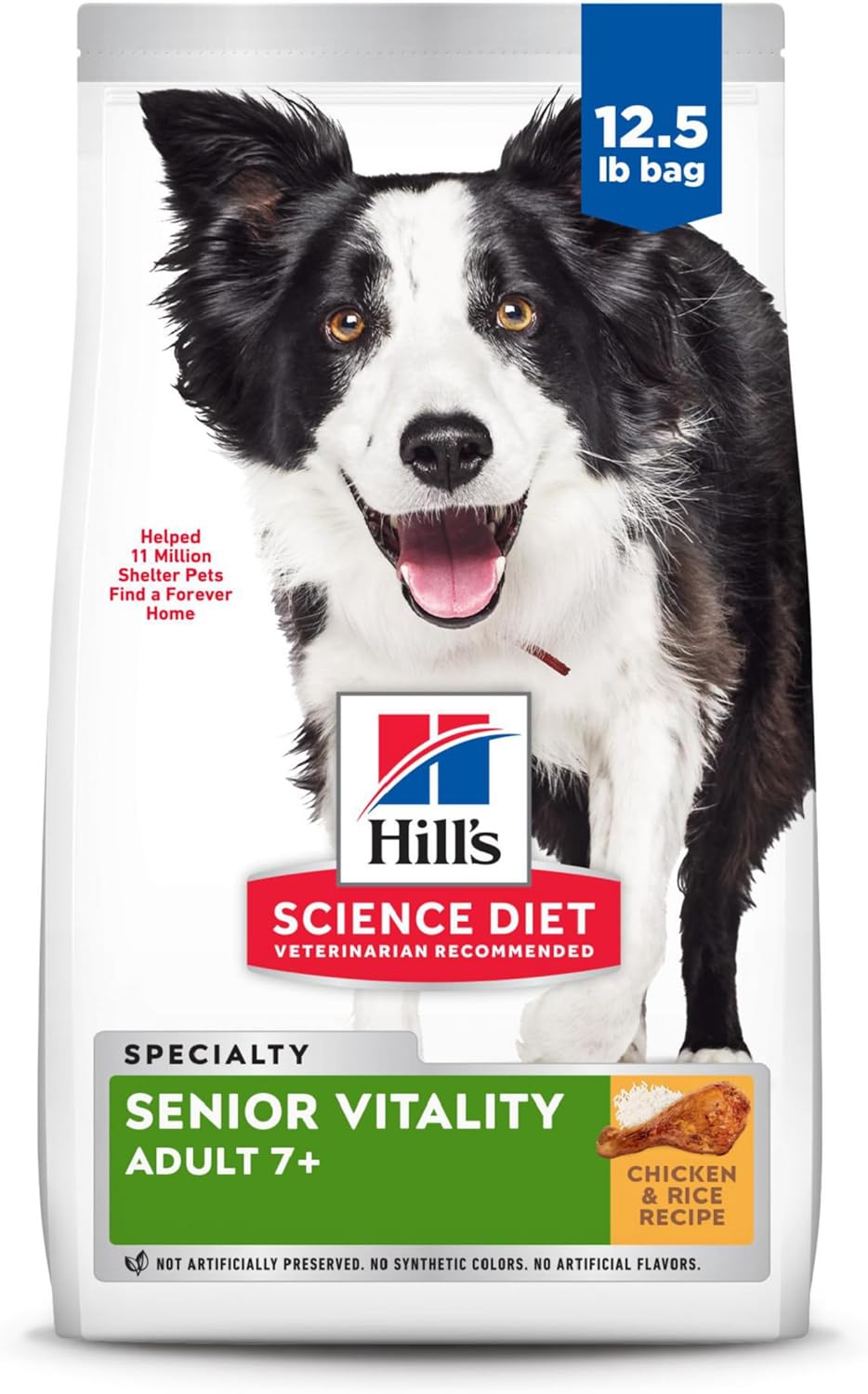
Key Features: Proprietary blend supports brain health, interaction, energy, and vitality | clinically proven antioxidants, vitamins C and E, for immune health | ingredients formulated to support heart health | easy for a mature dog’s stomach to digest
Pros: Broadest general senior support in one formula | most widely recommended and trusted senior brand among veterinarians | easily digestible for aging digestive systems | consistent, well-established formula
Cons: Contains corn gluten meal and wheat gluten, not grain-free | doesn’t target one specific symptom as precisely as the other formulas here
Best For: Owners switching to senior food proactively, before a specific symptom appears
Bottom Line: The reasonable default when you’re switching based on age alone, not a specific sign yet.
#2 If You’ve Noticed Mental Fog or Slower Learning: Purina Pro Plan Bright Mind
Overview: Chicken-based formula with enhanced botanical oils | shown to promote alertness and mental sharpness within 30 days | glucosamine and EPA for joint support | multiple bag sizes available
Why It’s Here: Around age 7, a dog’s brain begins metabolizing glucose differently, and Purina’s research specifically targeted that shift with botanical oils shown to improve memory, attention, and trainability. If your dog seems slower to respond or less engaged than they used to be, this is the formula built around that exact sign.
Purina Pro Plan
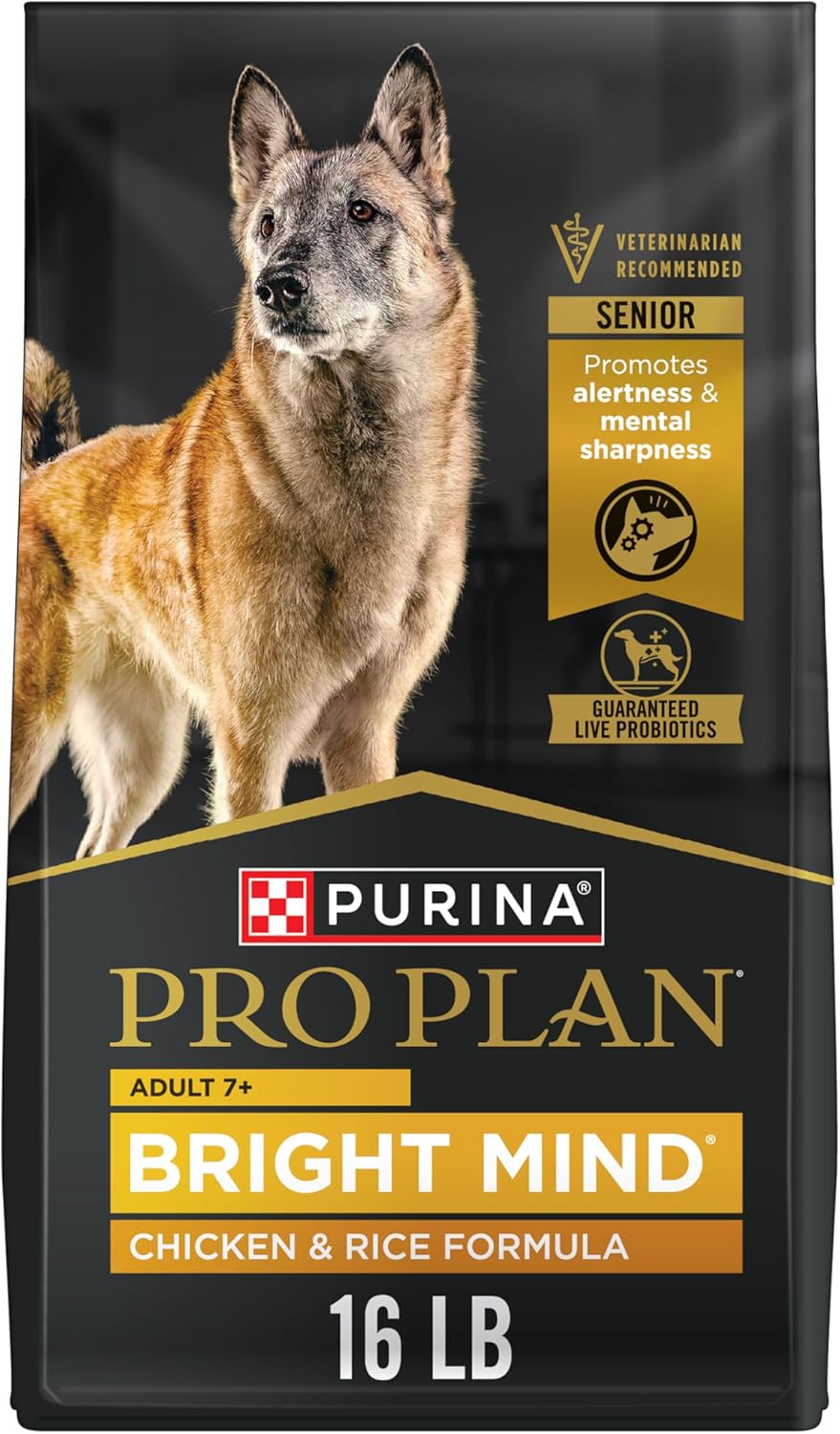
Key Features: Enhanced botanical oils provide an efficient alternative fuel source for the aging brain | glucosamine and EPA, an omega-3 fatty acid, support joint health and mobility | guaranteed live probiotics for digestive and immune health | chicken as the first ingredient
Pros: Backed by Purina’s own research showing improved alertness within 30 days | addresses cognitive and joint health together | high-quality protein supports muscle maintenance | widely available across size variants
Cons: Contains poultry by-product meal and corn gluten meal | premium pricing relative to everyday senior formulas
Best For: Dogs showing signs of mental fog, reduced interaction, or slower learning specifically
Bottom Line: The direct answer if cognitive changes are the sign you’ve actually noticed.
#3 If You’ve Noticed Stiffness or Reduced Mobility: Blue Buffalo Life Protection Formula Senior
Overview: Real chicken first ingredient | glucosamine and chondroitin for joint and hip health | antioxidant-rich LifeSource Bits | multiple bag sizes available
Why It’s Here: If the sign you’ve noticed is physical, slower to get up, hesitant on stairs, less interested in the walks they used to love, this formula puts glucosamine and chondroitin directly into the base recipe rather than treating joint support as an afterthought.
Blue Buffalo

Key Features: Real chicken as the first ingredient supports strong, healthy muscles | glucosamine and chondroitin support joint and hip health for mobility | exclusive LifeSource Bits deliver antioxidants formed at low temperature for potency | wholesome grains for gentle, regular digestion
Pros: Dedicated joint-support ingredients built into the base formula | formulated by veterinarians and animal nutritionists | free of poultry by-product meals, corn, wheat, and soy | strong reputation for improving mobility, per reviewers
Cons: Contains grains, so it’s not an option for grain-free needs | some senior dogs are reportedly picky about the kibble texture
Best For: Senior dogs showing physical signs of stiffness or reduced mobility specifically
Bottom Line: The direct answer if physical slowdown, not mental change, is what you’ve actually noticed.
#4 If You Want Natural Ingredients Specifically: Wellness Complete Health Age Advantage Senior
Overview: Chicken and barley recipe | glucosamine for joints, probiotics for digestion, taurine for heart health | made in the USA | multiple bag sizes available
Why It’s Here: This one isn’t matched to a physical or mental sign so much as a values-based preference: some owners specifically want a strict no-corn, no-wheat, no-soy standard alongside senior-specific support, and this formula delivers that without cutting joint or digestive benefits.
Wellness Complete Health

Key Features: Glucosamine supports strong joints | antioxidants support a healthy immune system | probiotics and taurine support digestive and heart health | free of poultry by-products, wheat, corn, and soy
Pros: Genuinely natural ingredient standard, not just marketed as such | covers joints, digestion, and heart health in a single formula | made in the company’s own USA facility | strong reputation for coat and digestive improvements
Cons: Slightly higher calorie content than some competitors, so portion control matters | less widely available than Hill’s or Purina at mainstream retailers
Best For: Owners who specifically prioritize a natural ingredient standard over targeting one symptom
Bottom Line: The pick when your deciding factor is ingredient philosophy, not a specific sign of aging.
#5 If Your Dog Is Large and Size Genuinely Changes Their Needs: Royal Canin Size Health Nutrition Large Aging 8+
Overview: Precise nutrition formulated for large dogs 8 years and older, weighing 56 to 100 lb | supports bone, joint, kidney, and heart health | small and medium variants also available
Why It’s Here: An 8-year-old Chihuahua and an 8-year-old Great Dane are aging in genuinely different ways, and this line exists specifically because size changes what senior nutrition should actually look like, not just portion size.
Royal Canin

Key Features: Precise calcium and phosphorus blend supports bone and joint health | minerals and amino acids support aging kidney and heart health | fibers and prebiotics promote optimal stool quality | kibble texture and shape matched to the dog’s size
Pros: Genuinely tailored to specific size categories, not a one-size-fits-all senior formula | supports kidney and heart health alongside joints | highly palatable, per reviewers | available in small, medium, and large breed variants
Cons: Contains chicken by-product meal, corn, and wheat gluten | requires selecting the correct size variant for your dog
Best For: Owners of large or giant breed seniors whose size genuinely changes their nutritional needs
Bottom Line: The pick if your dog’s size, not just their age, is part of the picture.
Pros & Cons Comparison Table
| Product | Top Pro | Top Con |
| Hill’s Senior Vitality | Broadest general senior support | Doesn’t target one specific sign |
| Purina Pro Plan Bright Mind | Research-backed cognitive improvement | Contains by-product meal |
| Blue Buffalo Life Protection Senior | Dedicated glucosamine and chondroitin | Contains grains |
| Wellness Age Advantage | Genuinely natural, no corn/wheat/soy | Slightly higher calorie content |
| Royal Canin Large Aging 8+ | Precisely tailored to size category | Must select correct size variant |
Which Sign Matches Your Dog?
Nothing specific stands out yet and you’re switching based on age alone, start with Hill’s Senior Vitality. Your dog seems mentally slower or less engaged, Purina Pro Plan Bright Mind targets that directly. If stiffness or reduced mobility is what you’ve noticed, Blue Buffalo Life Protection Senior addresses that. If a natural ingredient standard matters more to you than one specific symptom, Wellness Age Advantage fits. Dog is a large or giant breed, Royal Canin’s size-specific line accounts for needs a general senior formula won’t.
How to Match Senior Dog Food to What You’re Actually Seeing
Most owners searching for the best dog food for senior dogs have noticed something, even if they can’t quite name it yet. What “not working” looks like day-to-day varies a lot: one dog seems a little slower to get up, another seems mentally checked out during a walk, a third is just quietly gaining weight. The mistake many owners make is grabbing the first bag labeled “senior” without connecting it to what they’ve actually observed at home.
This matters because the ingredients that help joint stiffness, glucosamine and chondroitin, aren’t the same ones that help cognitive changes, botanical oils and DHA. A formula built around one sign won’t necessarily address the other as effectively, even if both are technically “senior” formulas. Large and giant breed dogs face this earlier than small breeds too, often needing senior support by age 5 or 6 instead of waiting until 8 or 9, since bigger dogs age faster on average.
Why Matching the Sign Beats Grabbing Any Senior Bag
Each formula in this comparison leads with a different mechanism: Hill’s leads with broad brain and immune support, Purina Pro Plan leads with research-backed cognitive ingredients, Blue Buffalo leads with dedicated joint-support additions, Wellness leads with ingredient purity, and Royal Canin leads with size-specific precision. Compared to picking based on brand recognition alone, matching the formula’s actual mechanism to what you’ve observed gives you a more targeted result. One thing worth knowing: these signs aren’t mutually exclusive. A dog showing both stiffness and mental fog might do well on a formula covering both, and it’s worth discussing your specific observations with your vet before choosing.
This guide is for owners who’ve noticed something in their aging dog but weren’t sure which formula actually addresses it. By the end of this section, you should be able to match what you’ve seen at home to the product built around that specific change.
Common Buying Mistakes to Avoid
- Grabbing any bag labeled “senior” without connecting it to what you’ve noticed. Different senior formulas target different signs. Match the formula’s actual mechanism to your dog’s specific situation.
- Assuming all senior dogs need less protein. Current veterinary thinking favors adequate, highly digestible protein to counteract natural muscle loss, not reduced protein simply because a dog is older.
- Waiting until symptoms are severe to switch. Joint and cognitive support ingredients work best introduced proactively, before a dog has already declined significantly.
- Ignoring your dog’s size when choosing a formula. A large breed senior has different bone, joint, and calorie needs than a small breed senior of the same age.
Practical Tips for Senior Dogs, By Sign
- For stiffness: Watch for hesitation on stairs or reluctance to jump, and pair a joint-focused formula with your vet’s guidance on supplements if needed.
- For mental fog: Keep a simple log of changes in alertness or routine confusion, so you and your vet can track whether a cognitive-focused formula is helping.
- For weight gain: Measure portions precisely rather than eyeballing them, since senior dogs typically need fewer calories due to reduced activity.
- For any sign: Transition gradually over 7 to 10 days, and schedule annual senior wellness exams to catch changes early.
Our Review Process
We evaluated every product on this list against the same criteria:
- Which specific sign of aging the formula is actually built to address
- Whether joint or cognitive claims are backed by real research
- Protein quality and digestibility for aging dogs
- Size-specific nutritional accuracy where applicable
- Real-world value per pound
We don’t make medical claims about any product, and every figure in this guide came from verified manufacturer or Amazon listing data. If your senior dog shows sudden changes in mobility, appetite, or behavior, a veterinarian can help rule out underlying conditions before you address it through diet alone.
For a full ranked comparison of these same formulas, our best senior dog food guide covers them in a traditional side-by-side ranking. For a broader look at dog nutrition, our best dog food guide compares budget, premium, and breed-specific options.
Final Recommendation
Only take one thing from this guide: match the formula to what you’ve actually noticed, not just your dog’s age on paper. If nothing specific stands out, Hill’s Senior Vitality is the reasonable broad default. Mental sharpness has changed, Purina Pro Plan Bright Mind is built specifically for that, backed by real research. If stiffness is the issue, Blue Buffalo’s dedicated joint ingredients address it directly.
This guide is built for anyone who’s noticed something in their aging dog but wasn’t sure which product actually fits. Match the sign to the formula, and loop in your vet if anything changes suddenly or seems severe.
Frequently Asked Questions About Best Dog Food for Senior Dogs
How do I know which senior dog food sign applies to my dog? Think about what you’ve actually observed: stiffness getting up or reluctance on stairs points to joint support, slower learning or reduced engagement points to cognitive support, and gradual weight gain points to calorie-conscious formulas, so match the product to the specific change rather than the word “senior” alone.
Can my dog show more than one sign of aging at once? Yes, this is common, and a dog showing both stiffness and mental fog, for example, might benefit from a formula addressing both, like one with both glucosamine and cognitive-support ingredients, which is worth discussing with your vet.
At what age should I start watching for these signs? Most dogs are considered senior around age 7, though large and giant breeds often show age-related changes earlier, around 5 to 6, since bigger dogs tend to age faster than small breeds.
Is it too late to switch senior food if my dog already has severe symptoms? It’s rarely too late to make a beneficial change, but severe or sudden symptoms should be evaluated by a vet first, since diet alone may not be sufficient and an underlying condition should be ruled out.
Should I switch food again if my dog develops a new sign later? Possibly. Since different formulas target different signs, a dog that develops a new symptom, like joint stiffness after already being on a cognitive-focused formula, may benefit from reassessing the fit with your vet at a future checkup.