

By the Pet Choice Center Editorial Team– Emma
Reviewed and researched by the Pet Choice Center Editorial Team. We compare pet products using manufacturer specifications, verified customer feedback, and practical buying criteria to help pet owners make informed decisions.
A note before you read on: kidney disease in cats is diagnosed through bloodwork, not symptoms alone, and most effective treatment diets require your veterinarian’s involvement. Four of the five products in this guide are prescription therapeutic diets. We’ve marked each one clearly and explained what that means.
Roughly one in three cats develops kidney disease at some point in their life. If your vet just delivered that diagnosis, you’re probably feeling overwhelmed by how many food options exist and how different they all are from each other. Finding the best cat food for kidney disease starts with understanding one core idea: these diets work by reducing phosphorus and often protein, which lowers the workload on kidneys that can no longer filter waste as efficiently as they used to.
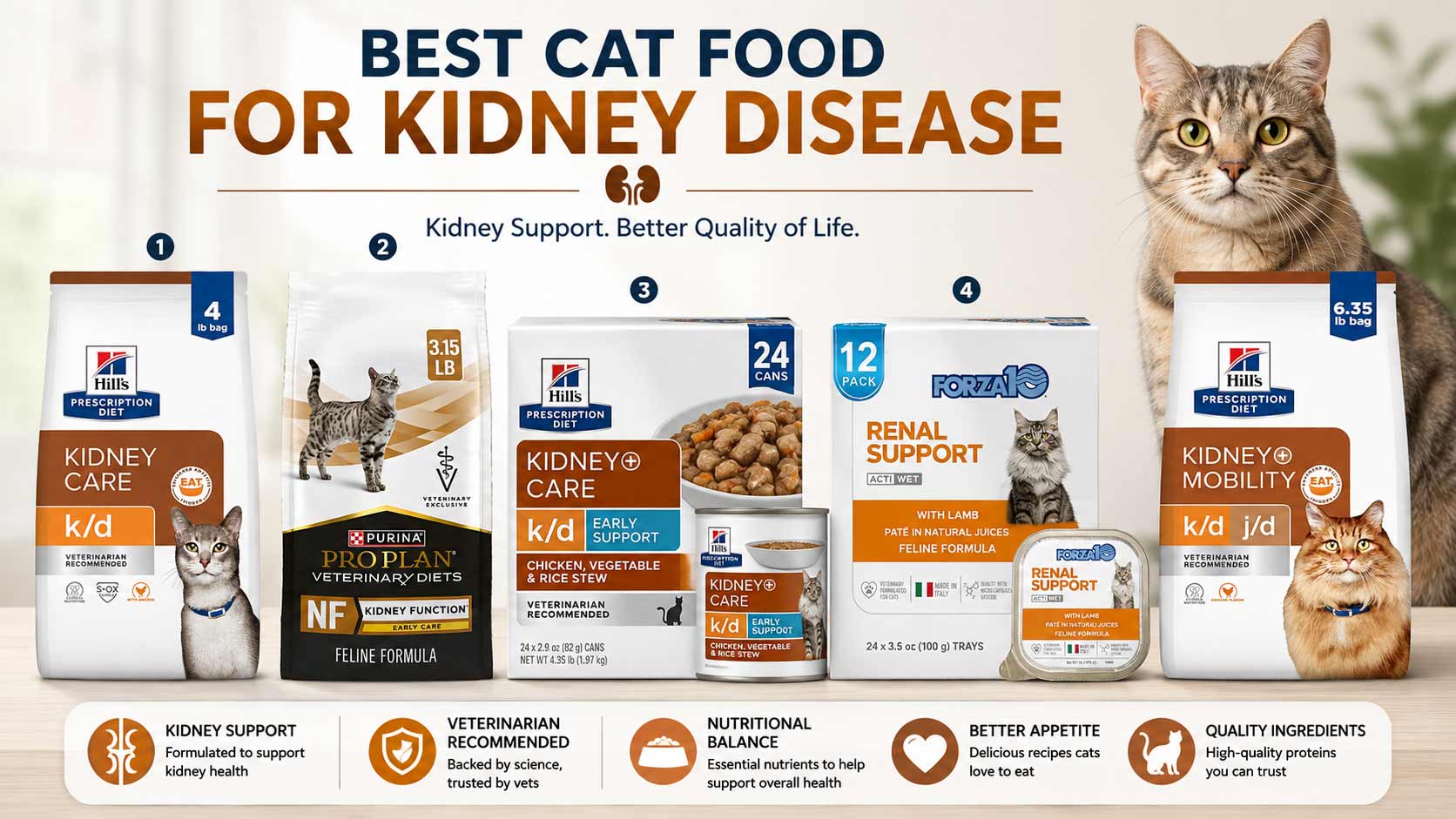
This guide covers both prescription therapeutic diets and one non-prescription renal-support option, in dry and wet formats. Every product here is for adult cats. Here’s a quick look at what we’re comparing:
- Hill’s Prescription Diet k/d Kidney Care Dry Cat Food, Chicken, 4 lb
- Purina Pro Plan Veterinary Diets NF Kidney Function Early Care, Adult Dry
- Hill’s Prescription Diet k/d Early Support Kidney Care Wet Cat Food, 24-Pack
- Forza10 Renal Wet Cat Food, Lamb Flavor, 12-Pack
- Hill’s Prescription Diet k/d Kidney Care + j/d Mobility Care Dry Cat Food, 6.35 lb
Quick Verdict
Hill’s Prescription Diet k/d is the most widely prescribed renal formula, backed by clinically proven nutrition and an appetite-stimulating technology that helps cats with reduced appetite keep eating. Purina Pro Plan NF Early Care offers a moderate-restriction alternative your vet may prefer for early-stage disease. The Hill’s wet stew adds hydration, which matters directly for kidney function. Forza10 stands apart as the one option here that doesn’t require a prescription. Hill’s k/d + j/d combines kidney and joint support for cats managing both conditions together.
Why Trust This Guide
These formulas by confirming exactly which ones require veterinary authorization to purchase and which don’t, since that distinction matters enormously for how you’ll actually get this food. We checked each formula’s approach to phosphorus and protein restriction against its own published data. We are not veterinarians. This guide cannot diagnose kidney disease or tell you which specific formula or disease stage applies to your cat. That determination belongs to your vet, based on bloodwork.
At a Glance
- 20+ hours spent researching renal-support formulas and their purchase requirements
- 3 brands compared across prescription and non-prescription options
- 5 features evaluated: phosphorus restriction, protein level, prescription status, format, and appetite support
- 5 products, four requiring veterinary prescription and one that doesn’t
Quick Comparison Table
Short on time? Here’s a quick side-by-side before you dive into the full breakdowns below.
| Rank & Product | Format | Restriction Level | Prescription Required | Best For |
| #1 Hill’s k/d Dry | Dry | Reduced phosphorus, sodium | Yes | Most widely prescribed |
| #2 Purina NF Early Care | Dry | Moderate phosphorus restriction | Yes | Early-stage disease |
| #3 Hill’s k/d Wet Stew | Wet | Reduced phosphorus, sodium | Yes | Added hydration |
| #4 Forza10 Renal | Wet | Reduced phosphorus, adapted protein | No | Non-prescription option |
| #5 Hill’s k/d + j/d | Dry | Reduced phosphorus, sodium | Yes | Kidney plus joint support |
Best Cat Food for Kidney Disease, Reviewed
Affiliate Disclosure: As an Amazon Associate Pet Choice Center may earn a commission from qualifying purchases. If you purchase through our links, we may earn a small commission at no extra cost to you. We only recommend products we genuinely stand behind.
#1 Hill’s Prescription Diet k/d Kidney Care, Chicken: Most Widely Prescribed
Overview: Chicken-based dry formula with reduced phosphorus and sodium | requires veterinary authorization to purchase | ActivBiome+ Kidney Defense prebiotic blend | 4 lb bag, larger sizes available
Why We Recommend It: This is the most widely recognized and prescribed renal formula among veterinarians, and it includes Enhanced Appetite Trigger technology specifically because reduced appetite is a common, serious complication of kidney disease.
Hill’s Prescription
Diet k/d Kidney Care

Pros: Most widely prescribed and recognized renal formula among veterinarians | appetite-stimulation technology addresses a real, common symptom | clinically proven nutrition, according to Hill’s published research | should be fed exclusively, without mixing in other foods, per Hill’s own guidance
Cons: Requires veterinary authorization to purchase, so you cannot simply add it to cart | exclusive feeding requirement means no mixing with regular food or treats
Best For: Cats with a vet-confirmed diagnosis whose vet has recommended this specific formula
Bottom Line: The benchmark renal diet most vets reach for first, though only your vet can confirm it’s right for your cat’s stage.
#2 Purina Pro Plan Veterinary Diets NF Kidney Function Early Care: Best for Early-Stage Disease
Overview: Moderate protein with restricted phosphorus | omega-3 fatty acids from fish oil | requires veterinary authorization to purchase | dry formula, standard bag sizes
Why We Recommend It: The “Early Care” name reflects a genuinely different approach: a moderate restriction level rather than the more aggressive reduction found in some renal diets, which some vets prefer for cats caught in the earlier stages of kidney disease.
Purina Pro Plan
Early-Stage Disease

Key Features: Moderate, high-quality protein rather than heavily restricted protein | restricted phosphorus supports kidney function | omega-3 fatty acids, a source of EPA and DHA | prebiotic fiber nourishes a healthy gut
Pros: Moderate restriction approach may suit early-stage disease specifically, per your vet’s guidance | omega-3 inclusion supports overall kidney and cardiac health | backed by Purina’s veterinary nutrition research | available in both dry and wet formats
Cons: Requires veterinary authorization to purchase | moderate restriction may not be appropriate for more advanced disease stages, which is a decision for your vet
Best For: Cats diagnosed in the earlier stages of kidney disease, based on your vet’s assessment
Bottom Line: A reasonable alternative to discuss with your vet if a moderate restriction level fits your cat’s specific stage.
#3 Hill’s Prescription Diet k/d Early Support Kidney Care Wet Cat Food: Best for Added Hydration
Overview: Chicken, vegetable, and rice stew | reduced phosphorus and sodium | requires veterinary authorization to purchase | 2.9 oz cans, 24-pack
Why We Recommend It: Hydration matters directly for kidney function, and wet food delivers significantly more moisture than kibble, which is exactly why many vets recommend at least partial wet feeding for cats managing kidney disease.
Hill’s Prescription Diet k/d
Support Kidney Care

Key Features: Stew texture with visible vegetables and rice | reduced phosphorus and sodium, consistent with the k/d line | recommended for cats diagnosed with early kidney disease | not recommended for growing kittens or pregnant or nursing cats
Pros: High moisture content directly supports hydration needs | stew texture and flavor often appeal to cats with reduced appetite | consistent renal support with the dry k/d formula | convenient can size for portion control
Cons: Requires veterinary authorization to purchase, same as the dry version | smaller cans mean more frequent purchases than a large dry bag
Best For: Cats needing extra hydration support alongside phosphorus restriction
Bottom Line: The wet answer when hydration is as much a priority as the phosphorus restriction itself.
#4 Forza10 Renal Wet Cat Food, Lamb Flavor: Non-Prescription Option
Overview: Pasture-raised lamb from New Zealand | adapted protein and controlled phosphorus | does not require a veterinary prescription | free of GMOs, by-products, wheat, and soy | 3.5 oz cans, 12-pack
Why We Recommend It: This is the one formula in our comparison you can purchase without a prescription, taking a nutraceutical approach with cranberries, dandelion, and clover extract alongside reduced protein and phosphorus levels typical of renal support.
Forza10 Renal
Non-Prescription Option

Key Features: Reduced protein and phosphorus levels support both kidney and cardiac function | cranberries, dried dandelion root, and dried clover extract for additional kidney support | high-moisture wet format supports hydration | free of corn, wheat, soy, and by-product meals
Pros: No prescription required, so it’s more accessible for owners still working with their vet on next steps | high-moisture format supports hydration alongside renal support | some owners report cats accepting this after refusing prescription options | ingredient list avoids common fillers and by-products
Cons: Not a substitute for a prescription diet if your vet has specifically recommended one | smaller can size and Italian import pricing run higher per ounce than domestic prescription options
Best For: Owners exploring renal support options while still discussing a full treatment plan with their vet
Bottom Line: Worth discussing with your vet as a non-prescription option, especially for a cat that has refused other renal diets.
#5 Hill’s Prescription Diet k/d Kidney Care + j/d Mobility Care: Kidney Plus Joint Support
Overview: Combines k/d renal support with j/d joint care in one formula | reduced phosphorus and sodium | requires veterinary authorization to purchase | 6.35 lb bag
Why We Recommend It: Kidney disease and joint mobility issues often show up together in older cats, and this formula addresses both without asking you to juggle two separate diets or figure out how to blend them yourself.
Hill’s Prescription
Diet k/d Kidney Care

Key Features: Combines renal support with joint mobility nutrition in a single formula | reduced phosphorus and sodium consistent with the k/d line | supports weight-bearing ability alongside kidney function | one formula instead of managing two separate diets
Pros: Solves two age-related conditions with one prescription diet | avoids the complexity of blending two separate specialized foods | backed by the same Hill’s renal research as standard k/d | larger bag size offers better value for long-term feeding
Cons: Requires veterinary authorization to purchase | only appropriate if your cat has been diagnosed with both conditions, which only your vet can confirm
Best For: Senior cats managing both kidney disease and joint mobility concerns
Bottom Line: A genuinely useful combination formula, but only if your vet has confirmed both diagnoses apply.
Pros & Cons Comparison Table
| Product | Top Pro | Top Con |
| #1 Hill’s k/d Dry | Most widely prescribed, appetite support built in | Requires prescription, exclusive feeding only |
| #2 Purina NF Early Care | Moderate restriction for early-stage disease | Requires prescription |
| #3 Hill’s k/d Wet Stew | High moisture supports hydration directly | Requires prescription, smaller cans |
| #4 Forza10 Renal | No prescription required | Higher cost per ounce than domestic options |
| #5 Hill’s k/d + j/d | Addresses kidney and joint issues together | Requires both diagnoses to be appropriate |
Who Should Buy Which Product?
None of these products should be chosen without your vet’s input, since kidney disease staging genuinely changes what a cat needs. That said: if your vet has recommended the most established renal formula, #1 Hill’s k/d Dry is the standard starting point. Your cat is in earlier-stage disease, ask your vet whether #2 Purina NF Early Care fits better. If hydration is a priority, #3 Hill’s k/d Wet Stew adds moisture directly. You’re still working through options with your vet, #4 Forza10 doesn’t require a prescription to try. If joint mobility is also a concern, #5 Hill’s k/d + j/d addresses both at once.
How to Choose the Best Cat Food for Kidney Disease
The number one reason people search for the best cat food for kidney disease is a diagnosis they didn’t see coming, since early kidney disease often shows no obvious symptoms until bloodwork reveals reduced kidney function. What “not working” looks like for an untreated diet is continued strain on kidneys that are already struggling to filter waste, which can accelerate disease progression over time. Most owners don’t realize how much phosphorus and protein levels matter until their vet explains why a specific therapeutic diet was recommended over a regular one.
The mistakes that come up most often involve confusion between prescription and non-prescription options, and uncertainty about whether a diet needs to be fed exclusively or can be mixed with other foods. This matters enormously, since some renal diets, like Hill’s k/d, are specifically meant to be fed alone without mixing in regular food, while a partial diet change may not provide adequate phosphorus restriction to matter. Multi-cat households face an added layer of complexity, since a renal diet formulated for one cat isn’t appropriate for a healthy cat in the same household.
Why Phosphorus Restriction Is the Core Mechanism
Reduced-phosphorus diets work by lowering the amount of waste product the kidneys have to filter, which can slow disease progression and ease symptoms in cats with reduced kidney function. Compared to a regular adult formula, therapeutic renal diets typically restrict phosphorus and moderate or reduce protein, though the exact level of restriction differs by product and by your cat’s specific disease stage. One thing worth understanding clearly: kidney disease in cats is staged using bloodwork and a system called IRIS staging, and the right level of dietary restriction genuinely depends on which stage your cat is in, which is exactly why this decision belongs with your vet rather than a general buying guide.
This guide is for owners who’ve just received a kidney disease diagnosis and are trying to understand the food landscape before their next vet appointment, and for those already managing the condition who want to compare formats and prescription requirements. By the end of this section, you should understand the real differences between these products, even though the final choice belongs to you and your veterinarian together.
Common Buying Mistakes to Avoid
- Buying a therapeutic renal diet without veterinary confirmation. Four of the five products here require prescription authorization for good reason. Kidney disease staging determines the right level of restriction, and that’s a medical decision.
- Mixing a prescription renal diet with regular food or treats. Some formulas, like Hill’s k/d, are specifically meant to be fed exclusively. Mixing dilutes the phosphorus restriction that makes the diet work.
- Assuming symptoms will show up before it’s serious. Early kidney disease often has no visible symptoms, which is why bloodwork, not observation, is how it’s actually diagnosed.
- Feeding a renal diet to other cats in a multi-cat household. These formulas are formulated for reduced kidney function specifically and aren’t appropriate for a healthy cat’s ongoing nutritional needs.
Practical Tips for Using Cat Food for Kidney Disease Effectively
- Get bloodwork before assuming a diet is needed at all. Kidney disease is diagnosed through blood and urine tests, not guesswork based on symptoms.
- Transition gradually, over 7 days or longer. Hill specifically recommends this timeline to avoid digestive upset and improve acceptance of the new diet.
- Ensure constant access to fresh water. Hydration support matters as much as the food itself for cats managing reduced kidney function.
- Follow up with your vet regularly. Kidney disease is a progressive condition that needs ongoing monitoring, not a one-time food purchase and done.
Our Review Process
We evaluated every product on this list against the same criteria:
- Phosphorus and protein restriction levels as published by the manufacturer
- Whether the product requires veterinary prescription authorization
- Format and hydration support
- Real-world palatability based on verified owner feedback
- Suitability across different stages of disease management, always with the caveat that staging is a veterinary decision
We don’t make medical claims about any product, and every figure in this guide came from verified manufacturer or retailer data. Kidney disease is a serious, progressive condition, and every recommendation here should be discussed with your veterinarian before you make a purchase, especially for any of the four prescription-only products.
If your cat is also dealing with weight concerns alongside kidney disease, our best cat food for weight loss guide covers weight-management formulas, though any dietary change for a cat with kidney disease should go through your vet first. Our best cat food guide offers a broader look at general nutrition if you want additional context.
Final Recommendation
If you only take one thing from this guide: talk to your vet before buying any of these products, since four require their authorization anyway and the fifth still deserves their input. Hill’s Prescription Diet k/d remains the most widely prescribed starting point that most vets reach for first. If hydration is a specific concern, the wet stew version adds meaningful moisture. If you’re exploring options while still working through a full treatment plan, Forza10 is worth raising with your vet since it doesn’t require prescription authorization to try.
This guide is built for anyone processing a kidney disease diagnosis and trying to understand the food landscape before their next vet visit. Bring this comparison to that appointment, and let your vet’s assessment of your cat’s specific disease stage guide the final decision.
More Guides for Cats with Kidney Disease
Food needs change as kidney disease progresses. These guides cover the next steps.
- Food for Cats with Kidney Disease: A Staging Guide for matching food to your cat’s stage
- Best Non-Prescription Food for Cats with Kidney Disease if your cat won’t eat prescription diets
- Best Cat Food for Cats with Kidney Disease: Verified Picks for another set of tested options
- Best Cat Food for Senior Cats since kidney problems are more common in older cats
Frequently Asked Questions About Cat Food for Kidney Disease
Do I need a prescription for kidney disease cat food? Most therapeutic renal diets, including Hill’s Prescription Diet k/d and Purina Pro Plan Veterinary Diets NF, require veterinary authorization to purchase, though some nutraceutical options like Forza10 are formulated for kidney support without requiring a prescription.
Why is phosphorus restricted in kidney disease cat food? Damaged kidneys struggle to filter phosphorus efficiently, and excess phosphorus buildup can accelerate kidney disease progression, which is why therapeutic renal diets specifically restrict phosphorus levels below what’s found in regular cat food.
Can I mix regular cat food with a prescription kidney diet? Generally, no. Formulas like Hill’s k/d are designed to be fed exclusively, since mixing in regular food dilutes the phosphorus and protein restriction that makes the therapeutic diet effective, though your vet can advise on your cat’s specific situation.
Is wet or dry food better for a cat with kidney disease? Many veterinarians recommend incorporating wet food specifically for the added moisture, since hydration support matters directly for cats with reduced kidney function, though both formats can provide appropriate phosphorus restriction depending on the specific product.
How is kidney disease actually diagnosed in cats? Kidney disease is diagnosed through bloodwork and urine testing that measure kidney function markers, not through symptoms alone, since early-stage disease often shows no visible signs until a veterinarian runs these specific tests.