

By the Pet Choice Center Editorial Team– Emma
Reviewed and researched by the Pet Choice Center Editorial Team. We compare pet products using manufacturer specifications, verified customer feedback, and practical buying criteria to help pet owners make informed decisions.
A note before you read on: kidney disease is staged through bloodwork, not symptoms, and four of the five products below require veterinary authorization to purchase. This guide explains how dietary needs shift across disease progression, but your vet determines your cat’s specific stage.
Introduction
Kidney disease isn’t one condition with one diet. It’s a spectrum, and vets use a staging system called IRIS to track where a cat falls on it, from mild, early changes to advanced disease. That staging genuinely affects what your cat should eat. A diet appropriate for early-stage disease can be too restrictive, or not restrictive enough, for a cat further along. Understanding food for cats with kidney disease means understanding that the “right” answer changes over time, not picking one bag and sticking with it forever.
This guide walks through what typically changes at each stage and matches real products to those situations, in both dry and wet formats. Here’s what we’re covering:
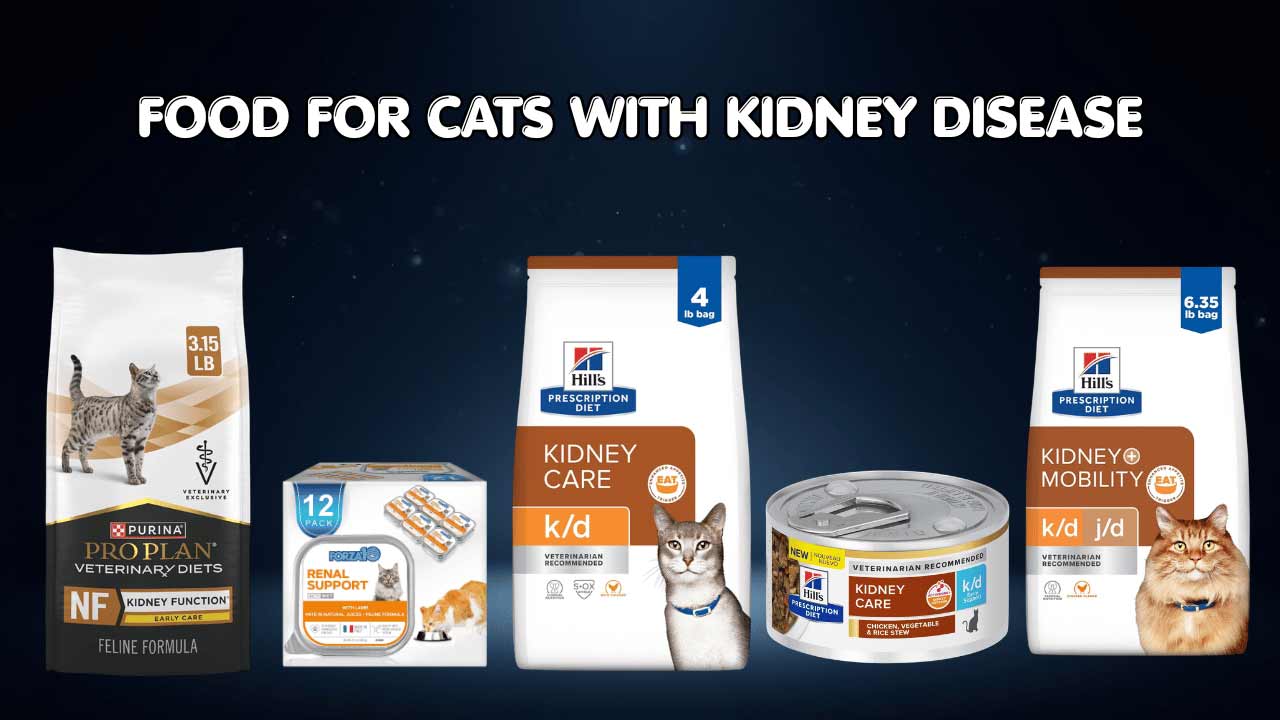
- Purina Pro Plan Veterinary Diets NF Kidney Function Early Care, Adult Dry
- Forza10 Renal Wet Cat Food, Lamb Flavor, 12-Pack
- Hill’s Prescription Diet k/d Kidney Care Dry Cat Food, Chicken, 4 lb
- Hill’s Prescription Diet k/d Early Support Kidney Care Wet Cat Food, 24-Pack
- Hill’s Prescription Diet k/d Kidney Care + j/d Mobility Care Dry Cat Food, 6.35 lb
Quick Verdict
Think of these five products as fitting three different points along the disease timeline rather than a single ranked list. Purina NF Early Care fits a moderate approach some vets choose for earlier-stage disease. Forza10 works as a non-prescription option worth raising with your vet at any stage. Hill’s k/d, in both dry and wet form, represents the more established restriction level often used from moderate stages onward. Hill’s k/d + j/d fits senior cats managing kidney disease alongside joint issues, a combination that becomes more common as cats age further into the disease.
Why Trust This Guide
We built this guide around how veterinary sources describe kidney disease staging and dietary management, rather than starting from a ranked product list and working backward. We confirmed the restriction level and prescription status of each product against its own published data. Not veterinarians, and staging a cat’s specific kidney disease requires bloodwork your vet performs, not information from this guide.
At a Glance
- 20+ hours spent researching how dietary needs shift across kidney disease stages
- 3 brands represented across different restriction approaches
- 4 stages of disease progression referenced, based on standard veterinary staging
- 5 products matched to different points along that progression
Quick Comparison Table
Short on time? Here’s a quick side-by-side before you dive into the full breakdowns below.
| Product | Restriction Approach | Prescription/Format | Typically Fits |
| Purina NF Early Care | Moderate | Yes/Dry | Earlier-stage disease |
| Forza10 Renal | Reduced protein/phosphorus | No/Wet | Any stage, vet discussion |
| Hill’s k/d Dry | Established, more restrictive | Yes/Dry | Moderate to advanced stages |
| Hill’s k/d Wet Stew | Established, more restrictive | Yes/Wet | Moderate to advanced, hydration focus |
| Hill’s k/d + j/d | Established restriction plus joint support | Yes/Dry | Advanced stage, senior cats |
How Food Needs Change Across Kidney Disease Stages
Affiliate Disclosure: As an Amazon Associate Pet Choice Center may earn a commission from qualifying purchases. If you purchase through our links, we may earn a small commission at no extra cost to you. We only recommend products we genuinely stand behind.
1# Purina Pro Plan Veterinary Diets NF Kidney Function Early Care: Fits a Moderate, Earlier-Stage Approach
Overview: Moderate protein with restricted phosphorus | omega-3 fatty acids from fish oil | requires veterinary authorization | dry formula
Why It’s Here: Earlier in kidney disease, some vets preferred a moderate restriction rather than the more aggressive approach used later, since overly restricting protein too soon can affect muscle mass in a cat that doesn’t yet need heavy restriction.
Purina Pro Plan
Earlier-Stage Approach

Key Features: Moderate, high-quality protein rather than heavily restricted protein | restricted phosphorus supports kidney function | omega-3 fatty acids support kidney and cardiac health | prebiotic fiber for gut health
Pros: Moderate approach may suit cats in earlier disease stages, per veterinary guidance | omega-3 content adds cardiac benefit alongside renal support | available in both dry and wet formats | backed by Purina’s veterinary nutrition research
Cons: Requires veterinary authorization to purchase | moderate restriction likely isn’t sufficient as disease advances, which is a decision for your vet to make over time
Best For: Cats whose vet has identified earlier-stage kidney disease
Bottom Line: A formula built around the idea that early disease doesn’t necessarily need the same restriction as advanced disease.
2# Forza10 Renal Wet Cat Food, Lamb Flavor: A Non-Prescription Option Worth Discussing at Any Stage
Overview: Pasture-raised lamb, reduced protein and phosphorus | does not require a prescription | cranberry, dandelion, and clover extract included | wet format
Why It’s Here: Because this one doesn’t require prescription authorization, it’s worth raising with your vet regardless of where your cat falls on the staging spectrum, whether as a standalone option or alongside a prescription diet your vet has also recommended.
Forza10 Renal
Worth Discussing at Any Stage

Key Features: Reduced protein and phosphorus support kidney and cardiac function | botanical additions like dandelion and cranberry for supplementary support | high-moisture wet format aids hydration | free of corn, wheat, soy, and by-product meals
Pros: No prescription required, useful while still working through a full plan with your vet | high moisture content supports hydration at any disease stage | some owners report success with cats that refused prescription options | avoids common fillers and by-products
Cons: Not positioned as a full substitute for a prescription diet at more advanced stages | higher cost per ounce than domestic prescription alternatives
Best For: Owners wanting a non-prescription option to discuss alongside their vet’s staging assessment
Bottom Line: Worth a conversation with your vet no matter which stage your cat is in.
3# Hill’s Prescription Diet k/d Kidney Care, Dry: Fits Moderate to Advanced Stages
Overview: Chicken-based formula with reduced phosphorus and sodium | requires veterinary authorization | ActivBiome+ Kidney Defense blend | dry format
Why It’s Here: As kidney disease advances, the restriction level typically needs to increase, and this is the more established, more restrictive formula many vets move to from moderate stages onward, especially once a cat has been on the diagnosis for a while.
Hill’s Prescription
Moderate to Advanced Stages

Key Features: Active Biome+ Kidney Defense supports gut microbiome balance | reduced phosphorus and sodium reflect a more established restriction level | Enhanced Appetite Trigger technology addresses reduced appetite, common as disease progresses | meant to be fed exclusively, without mixing other foods
Pros: Widely recognized and prescribed as disease moves past the earliest stages | addresses appetite loss directly, a common complication later in the disease | clinically studied nutrition, per Hill’s published research | dry format offers straightforward, measurable portions
Cons: Requires veterinary authorization to purchase | exclusive feeding requirement, so it can’t simply supplement a cat’s existing diet
Best For: Cats whose disease has progressed to a point where a vet recommends more established restriction
Bottom Line: The formula many vets reach for once earlier-stage approaches are no longer sufficient.
4# Hill’s Prescription Diet k/d Early Support Wet Stew: Adds Hydration as Disease Progresses
Overview: Chicken, vegetable, and rice stew | reduced phosphorus and sodium | requires veterinary authorization | wet format, 24-pack
Why It’s Here: Hydration needs often become more important as kidney disease progresses, since cats with reduced kidney function can struggle to concentrate urine effectively, and wet food delivers meaningfully more moisture than any dry formula.
Hill’s Prescription
k/d Early Support

Key Features: Stew texture with visible vegetables and rice | reduced phosphorus and sodium, matching the k/d dry formula | recommended starting point for early-diagnosed kidney disease | not appropriate for kittens or pregnant or nursing cats
Pros: High moisture content directly supports hydration, increasingly important as disease progresses | stew texture often appeals to cats with reduced appetite | consistent restriction level with the dry k/d formula | convenient portioned cans
Cons: Requires veterinary authorization, same as the dry version | smaller cans require more frequent purchasing than a large dry bag
Best For: Cats needing hydration support alongside phosphorus restriction, at any point past initial diagnosis
Bottom Line: Worth adding to the rotation specifically when hydration becomes a bigger priority.
5# Hill’s Prescription Diet k/d + j/d: Fits Advanced-Stage, Senior Cats With Joint Concerns
Overview: Combines k/d renal support with j/d joint mobility care | reduced phosphorus and sodium | requires veterinary authorization | dry format, 6.35 lb bag
Why It’s Here: Cats living with kidney disease long enough to reach advanced stages are often senior cats, and joint mobility issues frequently develop alongside that same aging process, which is exactly the overlap this formula addresses.
Hill’s Prescription
Fits Advanced-Stage

Key Features: Combines renal support with joint mobility nutrition | reduced phosphorus and sodium consistent with the k/d line | supports weight-bearing joint health alongside kidney function | avoids managing two separate specialized diets
Pros: Solves two age-related conditions common at this stage in one prescription diet | avoids the complexity of blending two specialized foods | backed by the same Hill’s renal research as standard k/d | larger bag size for longer-term feeding
Cons: Requires veterinary authorization | only appropriate once both conditions are actually diagnosed, which is a vet’s determination
Best For: Senior cats whose kidney disease has progressed alongside joint mobility concerns
Bottom Line: A combination formula that reflects how these two conditions often show up together later in a cat’s life.
Pros & Cons Comparison Table
| Product | Top Pro | Top Con |
| Purina NF Early Care | Moderate approach for earlier stages | Likely insufficient as disease advances |
| Forza10 Renal | No prescription required at any stage | Not a full substitute for prescription diets later on |
| Hill’s k/d Dry | Established restriction for progressing disease | Requires exclusive feeding, no mixing |
| Hill’s k/d Wet Stew | Directly supports increasing hydration needs | Smaller cans, more frequent purchasing |
| Hill’s k/d + j/d | Addresses two age-related conditions together | Only appropriate with both diagnoses confirmed |
Which Stage Does Each Product Typically Fit?
If your vet has identified earlier-stage disease, ask about Purina NF Early Care. If you want a non-prescription option to discuss regardless of stage, Forza10 fits that conversation. Once disease has progressed and a more established restriction level is needed, Hill’s k/d in dry form is the common next step. If hydration becomes a growing concern, add the Hill’s k/d wet stew. If your senior cat is managing both kidney disease and joint mobility issues, Hill’s k/d + j/d addresses both together.
How Food for Cats with Kidney Disease Should Change Over Time
Most owners searching for food for cats with kidney disease assume there’s a single correct answer they just need to find. In reality, veterinarians typically use a staging system called IRIS, based on bloodwork markers, to track kidney disease from mild, early changes through more advanced stages, and dietary recommendations shift accordingly. What gets missed is that a diet appropriate at diagnosis might need adjusting months or years later as the disease, if it progresses, moves into a later stage.
The mistake that costs owners the most confusion is assuming the first prescribed diet is permanent and never revisiting it at follow-up appointments. This matters because both under-restricting and over-restricting can cause problems. Too little phosphorus restriction may not adequately protect the kidneys as disease advances, while restricting protein too aggressively in earlier-stage disease can affect a cat’s muscle mass unnecessarily. Regular bloodwork and vet check-ins are what actually determine whether the current diet still fits.
Why Staging, Not Guesswork, Should Drive the Diet
Veterinary kidney disease staging relies on specific bloodwork markers that indicate how much kidney function remains, and that staging directly informs how aggressively phosphorus and protein should be restricted. Compared to picking a diet based on symptoms alone, staging-based decisions are more reliable, since early kidney disease frequently shows no obvious symptoms at all. One thing worth understanding: hydration support, often through wet food, tends to matter more as disease progresses, even when the core phosphorus restriction level stays similar.
This guide is for owners trying to understand why their vet might revisit the food conversation at follow-up appointments, and for those newly diagnosed trying to understand the bigger picture before their next visit. By the end of this section, you should understand that food for cats with kidney disease isn’t a one-time decision, it’s an ongoing conversation with your vet as the disease, and your cat’s needs, potentially change.
Common Buying Mistakes to Avoid
- Assuming the first prescribed diet never needs revisiting. Kidney disease can progress, and dietary needs sometimes shift with it. Regular vet check-ins matter more than a one-time food decision.
- Choosing based on restriction level alone without knowing your cat’s stage. A heavily restricted diet isn’t automatically better if your cat is in earlier-stage disease, and your vet’s bloodwork results should guide this choice.
- Underestimating the growing importance of hydration. Wet food and fresh water access often matter more as kidney disease advances, not just at diagnosis.
- Skipping follow-up bloodwork because the cat seems fine. Kidney disease often shows few visible symptoms even as it progresses, which is exactly why monitoring matters more than how a cat looks day to day.
Practical Tips for Managing Food for Cats with Kidney Disease
- Ask your vet when to expect a staging recheck. Bloodwork on a regular schedule is how you’ll know if the current diet still fits.
- Introduce any new diet gradually, over 7 days or more. This improves acceptance and reduces digestive upset during the transition.
- Prioritize water access alongside diet. Multiple water stations and wet food both support hydration, which becomes increasingly important over time.
- Keep a simple log of appetite and weight. Changes in either can be early signs worth mentioning at your next vet visit, rather than waiting for the next scheduled appointment.
Our Review Process
We evaluated every product on this list against the same criteria:
- How its restriction approach aligns with different points in disease progression
- Whether it requires veterinary prescription authorization
- Format and hydration support
- Real-world palatability based on verified owner feedback
- Suitability for combination conditions, like kidney disease alongside joint mobility issues
We don’t make medical claims about any product, and every figure in this guide came from verified manufacturer data. Kidney disease staging and treatment decisions belong to you and your veterinarian, based on your cat’s actual bloodwork, not general information from this guide.
For a full ranked comparison of these same formulas, our best cat food for kidney disease guide covers them in a more traditional side-by-side format. Our best cat food guide offers broader nutrition context if you’re looking beyond kidney-specific concerns.
Final Recommendation
If you only take one thing from this guide: your cat’s food needs may shift as kidney disease progresses, so treat this as an ongoing conversation with your vet rather than a single decision. Ask where your cat currently falls on the staging spectrum, and let that guide whether Purina NF Early Care, Hill’s k/d, or another approach fits best right now, knowing that answer may change at future check-ins.
This guide is built for anyone trying to understand the bigger picture of kidney disease management, not just shopping for one bag of food. Bring your questions to your next vet visit, and expect the food conversation to potentially evolve as your cat’s bloodwork does.
Frequently Asked Questions About Food for Cats with Kidney Disease
Does my cat’s kidney disease diet need to change over time? It can. Veterinarians often reassess diet at follow-up bloodwork appointments, since kidney disease is staged on a spectrum and dietary restriction needs can shift as the disease progresses.
What is IRIS staging for cat kidney disease? IRIS staging is a veterinary system that classifies kidney disease into stages based on bloodwork markers, and it helps determine how aggressively a cat’s diet and treatment plan should be adjusted at each stage.
Why did my vet recommend a different food than my cat’s previous kidney diet? This often reflects a change in disease stage identified through bloodwork, where an earlier, more moderate diet may no longer provide enough restriction, or in some cases, may have been more restrictive than currently needed.
Is it normal for kidney disease to have no symptoms early on? Yes, this is common. Early-stage kidney disease frequently shows no visible symptoms, which is why bloodwork, not how a cat looks or acts, is how vets actually detect and stage the disease.
Should I switch to wet food as my cat’s kidney disease progresses? Many vets recommend incorporating more wet food as kidney disease advances, since hydration support becomes increasingly important, though your vet can advise on the right balance for your cat’s specific stage.