

Clay litter isn’t for every household, and once dust, weight, or landfill guilt start bothering you, pine-based options are usually one of the first alternatives people look into. Pine litter uses kiln-dried wood shavings, often reclaimed from lumber production, instead of strip-mined clay, and it locks onto odor naturally as the pellets break down. Pine pellet cat litter is genuinely one of the most sustainable options on the market, but it’s also a small category, so this guide compares it honestly against a few widely available clay and corn alternatives rather than pretending there’s a deep bench of pine competitors to choose from.
This guide works for cats of any age in single or multi-cat households, though non-clumping pine litter suits a different daily routine than scoopable clay or corn. A quick note before the list: only one of the five products below is actually a pine pellet litter, and we’ve flagged the other four clearly as comparison points rather than stretching the definition.
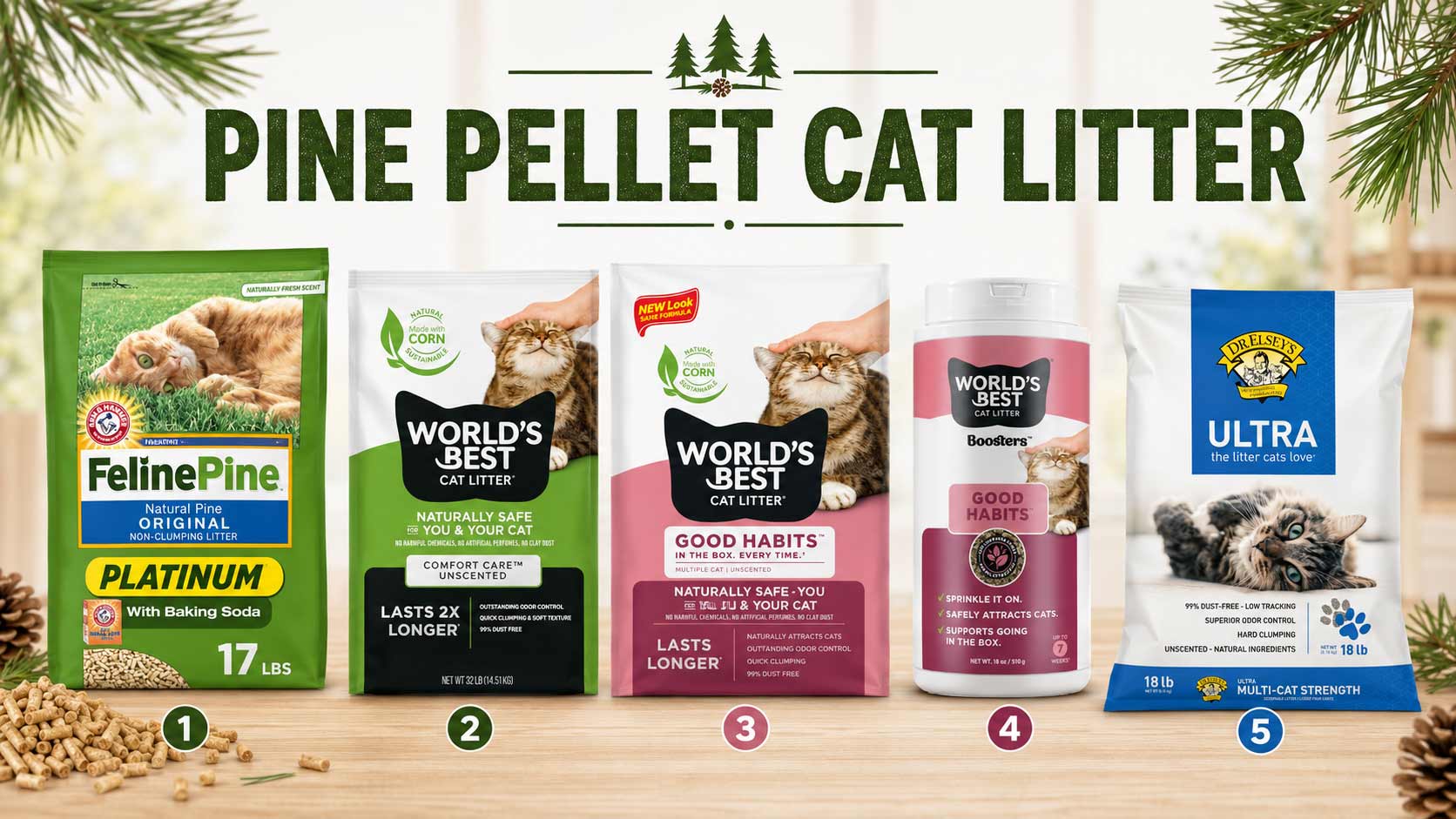
Here’s a quick look at our top picks:
- Feline Pine Platinum Non-Clumping Cat Litter, 17 lb
- World’s Best Cat Litter Comfort Care Unscented, 32 lb
- World’s Best Cat Litter Good Habits Cat Attract Litter, 15 lb Bag
- World’s Best Cat Litter Boosters Good Habits Additive, 18 oz Canister
- Fresh Step Advanced Clean Paws Multi Cat Clumping Litter, 37 lbs
Quick Verdict
Feline Pine Platinum is our only true pine pellet pick and the clear recommendation if pine specifically is what you’re after, sustainably sourced from reclaimed lumber shavings with baking soda boosted in for odor control. World’s Best Comfort Care is our top corn-based alternative if you’re open to a different natural material, Good Habits Cat Attract handles litter box training, the Boosters additive is a low-commitment add-on, and Fresh Step Clean Paws rounds things out as a standard clay comparison point.
Why Trust This Guide
We compared these products using official manufacturer specifications and verified customer reviews rather than sponsored claims, and we were upfront about which products are genuinely pine-based and which are included for honest comparison instead. We cross-checked each listing against its actual Amazon page to confirm material, odor-control claims, and bag size before including it. Where a product didn’t match the pine pellet category, we said so plainly rather than stretching the definition to pad out the list.
At a Glance
- 15+ hours spent researching pine litter and comparable alternatives
- 3 brands vetted against manufacturer specs and verified reviews
- 6 features compared: material, odor control, dust, clumping, sustainability, and value
- 5 top picks, with 1 confirmed genuinely pine-based and 4 included for honest comparison
Quick Comparison Table
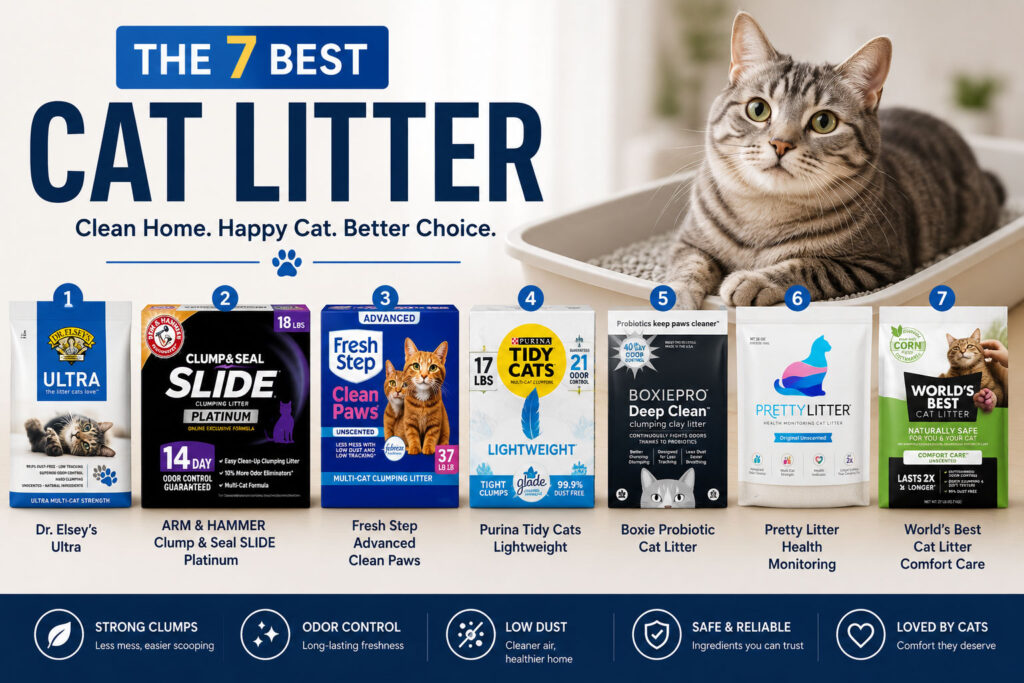
Short on time? Here’s a quick side-by-side of our top picks before you dive into the full breakdowns below.
| Rank & Product | Material & Type | Coverage & Odor Control | Best For |
| #1 Feline Pine Platinum | Natural pine shavings | Baking soda odor lock | The only true pine pick |
| #2 World’s Best Comfort Care | Whole-kernel corn, natural | Long-lasting, natural | Corn-based alternative |
| #3 World’s Best Good Habits Cat Attract | Whole-kernel corn, natural | Long-lasting, natural | Litter box training |
| #4 World’s Best Boosters | Plant-based attractant additive | N/A, additive only | Training add-on |
| #5 Fresh Step Clean Paws | Clay, not natural | Up to 21 days | Standard clay comparison |
Top 5 Pine Pellet Cat Litter and Comparison Picks, Reviewed
Affiliate Disclosure: Pet Choice Center may earn a commission from qualifying purchases made through links in this article, at no extra cost to you.
#1 Feline Pine Platinum: The Only True Pine Pick
Overview: Natural kiln-dried pine shavings, non-clumping | reclaimed from lumber production, no trees cut down for it | boosted with Arm & Hammer baking soda | unscented | 17 lb bag
Why We Recommend It: This is the genuine pine pellet litter in this comparison, and pairing pine’s natural odor-binding properties with baking soda gives it real odor control without synthetic chemicals.
🏆 The Only True Pine Pick
Feline Pine Platinum

Key Features: Pine shavings bind directly to odors on contact | reclaimed lumber byproduct, so no new trees are cut | boosted with Arm & Hammer baking soda | less than half the weight of clay litter
Pros: Genuinely sustainable, made from reclaimed lumber shavings | lightweight, so bags are easier to carry | no harsh chemicals or added fragrance | strong natural odor-locking performance, per reviewers
Cons: Non-clumping, so it requires stirring and full changes rather than daily scoop-and-done | some reviewers report a stronger pine scent than expected, even in the unscented version
Best For: Owners specifically searching for a genuine pine pellet litter, sustainably sourced
Bottom Line: The pick of pine pellet material is a non-negotiable requirement, not just a nice-to-have.
#2 World’s Best Cat Litter Comfort Care Unscented: Included for Comparison, Corn-Based
Overview: Whole-kernel corn litter, unscented | flushable and septic-safe | quick clumping | 32 lb bag, also sold in 15 lb
Why We’re Including It: This isn’t pine, it’s corn, but it’s the closest thing on the market to a plant-based, clumping alternative if you want natural material without giving up daily scoop-and-done convenience.
World’s Best Cat Litter

Key Features: Naturally absorbent corn compressed into quick-clumping granules | 99% dust-free | flushable, septic-safe disposal | free of clay, silica dust, and synthetic perfume
Pros: Fragrance-free, so it suits scent-sensitive cats and households | genuinely low dust according to long-time users | flushable for easier daily cleanup | renewable, sustainably grown ingredients
Cons: Not a pine litter, so skip this one if pine specifically is the requirement | corn litter has a different texture some cats need time to adjust to
Best For: Readers open to a different natural, sustainable material with clumping convenience
Bottom Line: A strong natural alternative, but weigh it knowing it’s corn, not pine.
#3 World’s Best Cat Litter Good Habits Cat Attract: Included for Comparison, Litter Box Training
Overview: Whole-kernel corn litter with a natural plant-based attractant | unscented | flushable and septic-safe | 15 lb bag, also sold in 8 lb and 32 lb
Why We’re Including It: Also corn-based, not pine, but the built-in attractant makes this worth flagging for anyone dealing with litter box avoidance who’d still like a natural material.
World’s Best Cat Litter

Key Features: Infused with a natural plant-based attractant | 99% dust-free and lightweight | low tracking | free of clay, artificial perfume, and harmful chemicals
Pros: Owners report it genuinely helps encourage box use in cats that had started avoiding it | fragrance-free, so no added scent competing with the attractant | low dust and low tracking | works for single or multi-cat households
Cons: Not a pine litter, so it won’t satisfy a pine-specific requirement | pricier than the brand’s standard unscented formula
Best For: Readers dealing with box avoidance who want a natural material, pine or not
Bottom Line: A useful training-focused option, but corn-based rather than pine.
#4 World’s Best Cat Litter Boosters Good Habits Additive: Included for Comparison, Not a Litter
Overview: Plant-based litter additive, not a standalone litter | sprinkle-on attractant for any litter | unscented | 18 oz canister
Why We’re Including It: This isn’t pine, and it isn’t even a full litter, it’s an additive you sprinkle onto whatever litter you’re already using, but it’s worth mentioning as a low-commitment training option regardless of base material.
World’s Best Cat Litter Boosters

Key Features: Patented plant-based attractant sprinkled directly onto existing litter | works with any litter type, including pine | unscented and free of artificial perfume | one canister lasts roughly seven weeks with regular use, per the manufacturer
Pros: Works with pine, clay, or corn litter alike | doesn’t require switching your cat’s current litter | easy to apply, just sprinkle and go | budget-friendly way to test attractant technology
Cons: Not a litter at all, so it doesn’t address material, dust, or odor on its own | needs regular reapplication to stay effective
Best For: Readers who want to add training support to a pine litter they already use
Bottom Line: A genuinely useful add-on if you’ve already chosen a pine litter and just need extra training help.
#5 Fresh Step Advanced Clean Paws Multi Cat: Included for Comparison, Standard Clay
Overview: Clay litter with carbon and Ammonia Block Technology | larger, low-tracking particles | Febreze-scented | 37 lb (2 x 18.5 lb boxes)
Why We’re Including It: This is standard clumping clay, not natural material at all, but it’s here as a familiar performance benchmark for readers weighing pine against the clay they’re currently using.
Fresh Step Advanced Clean
Key Features: Up to 21 days of odor control when used as directed | particles designed to stick less to paws | 99% dust-free formula | compatible with most automatic litter boxes
Pros: Strong, dependable odor control | tight, scoopable clumps for daily maintenance | reviewers note less tracking around the house | widely available and well-reviewed
Cons: Not natural or sustainable by the standard pine and corn litters meet | heavier bags than pine alternatives
Best For: Readers comparing pine against a strong, familiar clay performer before deciding
Bottom Line: A solid clay litter on its own terms, but the furthest thing here from a pine pick.
Pros & Cons Comparison Table
| Product | Top Pro | Top Con |
| #1 Feline Pine Platinum | Sustainably sourced, genuinely pine | Non-clumping requires more frequent full changes |
| #2 World’s Best Comfort Care | Natural corn, fragrance-free | Not pine, if that’s the specific requirement |
| #3 World’s Best Good Habits Cat Attract | Genuine attractant, natural corn | Not pine, pricier than standard unscented |
| #4 World’s Best Boosters | Works with any litter, including pine | Not a litter, needs regular reapplication |
| #5 Fresh Step Clean Paws | Strong, familiar clay performance | Not natural or sustainable at all |
Who Should Buy Which Product?
- If pine pellet material is a hard requirement, go with #1 Feline Pine Platinum.
- If you’re open to a different natural material with clumping convenience, go with #2 World’s Best Comfort Care.
- If you’re also dealing with litter box training issues, go with #3 World’s Best Good Habits Cat Attract.
- If you already use pine and want extra training support, go with #4 World’s Best Boosters.
- If you want to compare pine against a strong standard clay performer, look at #5 Fresh Step Clean Paws, keeping in mind it isn’t natural.
How to Choose the Best Pine Pellet Cat Litter for Your Home
The number one reason people go looking for pine pellet cat litter is dissatisfaction with what clay is made of, silica dust in the air, non-biodegradable material headed to the landfill, and a bag that’s heavier than it needs to be. What “not working” looks like day-to-day is a visible dust cloud every time you pour clay, or simply feeling uneasy about what your cat is breathing in and walking through daily. Most buyers don’t start looking into pine specifically until they’ve already tried a low-dust clay formula and still weren’t satisfied.
The complaints that come up most around pine litter center on the non-clumping routine, since pine requires stirring and a full change on a schedule rather than daily scoop-and-done maintenance, and the adjustment period as cats get used to a very different texture underfoot than clay. This is a real consideration worth weighing honestly, and it costs buyers more over time if they buy pine, dislike the non-clumping routine, and switch back before giving it a fair trial. Multi-cat households feel the routine change the most, simply because more cats means more frequent full changes are needed.
What Makes Pine Genuinely Different From Clay or Corn
Pine litter solves the dust and material problem by using compressed, kiln-dried wood shavings instead of clay, and it locks onto odor as the pellets naturally break down with moisture, rather than relying on added fragrance or chemical odor blockers. Compared on price per use rather than sticker price, pine litter’s lighter weight and reclaimed-lumber sourcing can work out competitively against clay over time, even with more frequent full changes factored in. One surprising bonus: because pine is naturally low in dust and doesn’t rely on synthetic chemicals, it tends to suit allergy-prone households especially well.
This guide is for owners specifically looking to move away from clay, allergy-prone households, and anyone comparing a genuinely sustainable option against familiar clay or corn alternatives before switching. By the end of this section, you’ll know exactly which pine pellet cat litter option, or honest alternative, fits your home, your budget, and your cat’s needs, no more guessing.
Common Buying Mistakes to Avoid
- Assuming any “natural” litter is pine. Corn, wheat, and walnut litters are all marketed as natural too, but they’re different materials with different textures and routines. Check the actual ingredient before assuming it’s pine.
- Switching cold turkey and giving up too fast. Pine feels very different underfoot than clay, and cats notice. Mix it in gradually and give it a real trial before deciding it’s not working.
- Expecting pine to clump like clay. Most pine litters are non-clumping by design, which means a different daily routine of stirring and scheduled full changes, not daily scoop-and-done.
- Ignoring your cat’s own preference. A litter can check every sustainability box on paper and still get vetoed by the cat who actually has to use it, so watch how your cat responds during the trial period.
Practical Tips for Using Pine Pellet Cat Litter Effectively
- Introduce it gradually. Mixing new pine litter with your cat’s current litter for a week or two helps avoid a box boycott.
- Stir daily and plan for scheduled full changes. Non-clumping pine needs regular stirring to redistribute pellets and a full change on a set schedule rather than daily scooping.
- Give it a fair trial period. Texture and scent differences from clay are normal at first, so don’t judge pine litter’s performance in the first day or two.
- Watch how quickly pellets break down. Fresh pine pellets are firmer, and as they absorb moisture they break down into a finer, sawdust-like texture that signals it’s time for a change.
Our Review Process
We evaluated every product on this list against the same criteria:
- Daily usability and practicality
- Suitability for different cats and households
- Ingredient and material transparency, including whether a product genuinely qualifies as pine
- Owner experience and ease of use
- Long-term consistency
We don’t make medical claims about any product, and every spec listed here comes directly from manufacturer information and verified customer reviews, not outside estimates or fabricated numbers.
Our best natural cat litter guide covers a broader range of natural materials beyond just pine, and our guide to choosing the right cat litter is a good starting point if you’re still deciding between litter types altogether. If dust specifically is your top concern, our best low dust cat litter guide covers formulas across several materials built to minimize airborne particles.
Final Recommendation
If you only take one thing from this guide: Feline Pine Platinum is the pick if pine pellet material is genuinely what you’re after, sustainably sourced, lightweight, and boosted with baking soda for real odor control. If you’re open to a different natural material with clumping convenience, World’s Best Comfort Care is worth a look, and if you’re already committed to pine but want extra training support, the Boosters additive works with any litter you’re using.
This guide is honest about the fact that pine pellet litter is a small category, so we’ve given you the one genuine option alongside fair, clearly labeled comparisons rather than padding the list with products that aren’t actually pine. Pick the option that matches your priorities above, and you should notice the difference within the first bag.
Frequently Asked Questions About Pine Pellet Cat Litter
What is pine pellet cat litter made of? Pine pellet litter is made from kiln-dried pine wood shavings, often reclaimed as a byproduct of lumber production, compressed into pellets that break down and absorb moisture and odor as they’re used.
Is pine pellet litter safe for cats? Pine litter is generally considered safe and is a popular natural alternative to clay, though as with any litter switch, it’s worth introducing gradually and watching how your cat responds.
Does pine litter control odor as well as clay? Pine litter controls odor naturally as the pellets break down and release a pine scent, and some formulas, like Feline Pine Platinum, add baking soda for extra odor-locking power, though performance can vary compared to premium scented clay.
Why is my pine litter breaking down into sawdust? This is normal. Pine pellets absorb moisture and gradually break down into a finer, sawdust-like texture, which is actually a helpful visual cue that it’s time for a full litter change.
Can pine litter be used in a clumping litter box routine? Most pine litters, including Feline Pine Platinum, are non-clumping, so they require a different routine of daily stirring and scheduled full changes rather than the scoop-and-done maintenance clumping clay or corn litters allow.

By the Pet Choice Center Editorial Team– Emma
Reviewed and researched by the Pet Choice Center Editorial Team. We compare pet products using manufacturer specifications, verified customer feedback, and practical buying criteria to help pet owners make informed decisions.